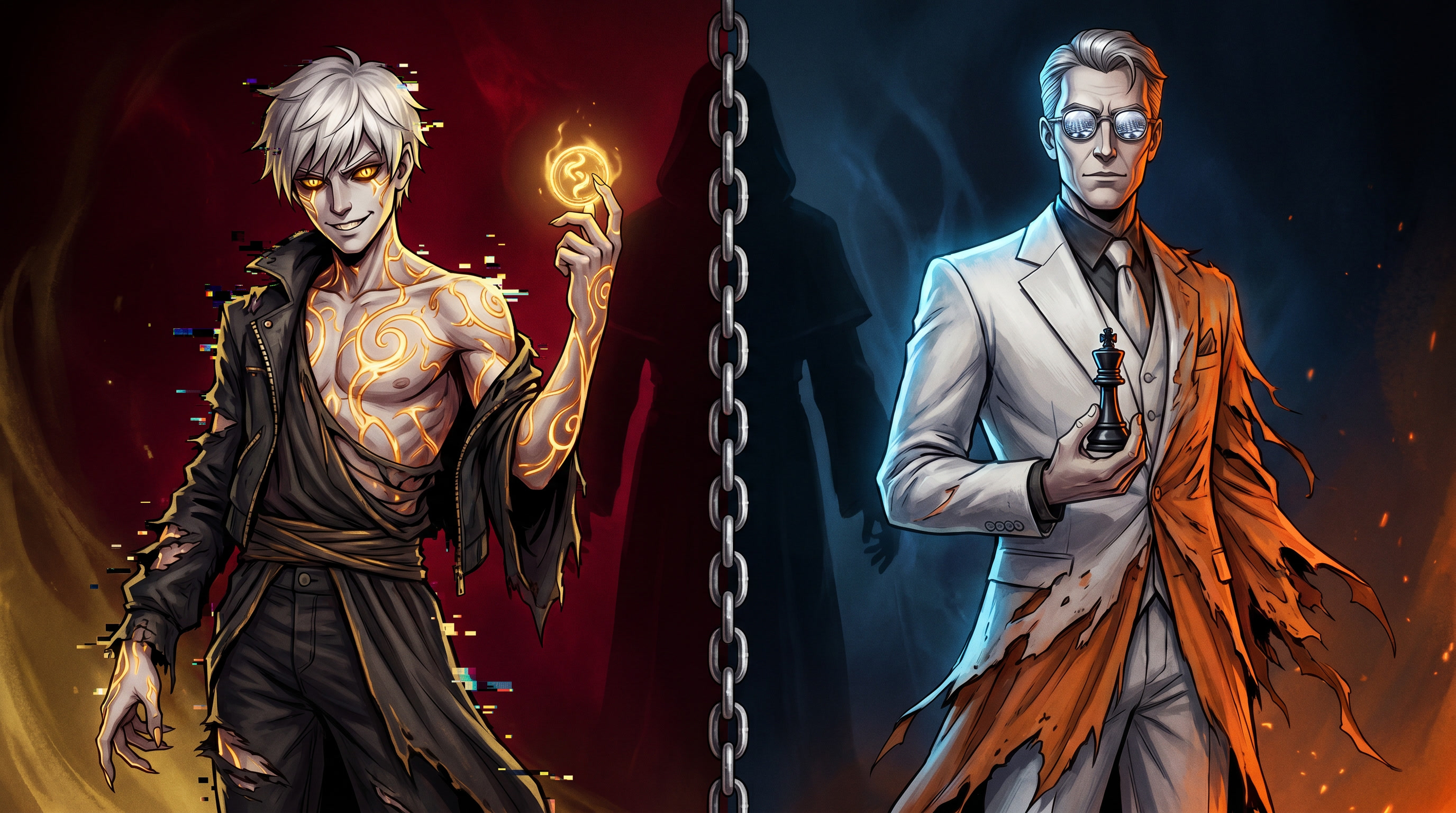
The demons of EXORCISTA: Games of Souls are not generic horror monsters. Each one is a specific sin, a specific game, a specific weakness. Every host follows the same rule set: their sin determines the game, their game determines the format of every episode they appear in, and their weakness determines how they lose. Exorcista collects every loser. Two demons have appeared on screen so far. Eight more are coming through Season 1. This is the canonical guide to who they are, where their names come from, and what kind of game each will host.
How the Universe casts demons: one sin, one game, one weakness
Every demon in this universe is built on a three-part formula by Victoria Unikel and the Show Bible:
- Sin — one of the deadly sins, taken seriously. Greed, pride, lust, envy, sloth, wrath, gluttony, plus modified contemporary sins (vanity, knowledge, control, performance).
- Game — a lethal game whose mechanic embodies the sin. Greed gets games of accumulation. Knowledge gets games of strategy. Wrath would get games of speed and force.
- Weakness — a structural defect that follows from the sin. Greed cannot stop. Knowledge cannot admit it was wrong. Pride cannot lose face. The weakness is always the thing that ends them.
This is also why the show works as an anthology rather than a serial. Each demon is a complete unit. The universe doesn't need a season-long villain — every episode is a fresh demon, a fresh sin, a fresh game, a fresh defeat. The constant is the collector.
Mammon — greed, Russian roulette, can't refuse a bet
Sin: GREED. Game: Russian roulette. Weakness: Cannot refuse a bet. Hosted: EP1 — The Influencer, May 1, 2026.
Mammon is the demon of accumulation. In our Universe he is the game show host of Hell, which is to say he runs the public-facing portion of every episode that takes place inside Content Hell — the chamber, the velvet curtains, the confetti cannon, the announcer-voice monologue.
Visual signature: a $5,000 designer hoodie that splits open across the episode to reveal ancient demon robes and runic skin underneath. Golden dollar-sign eyes that spin faster the more he wants something. Vampire fangs partially visible. American accent. Smooth, charming, tech-bro energy. A version of every founder-cult bro you've ever seen post a "trust the process" thread.
The defeat structure: Mammon cheats his way through every game. In EP1 he uses a hidden card move during the chamber sequence — pulling a "rule" out of nowhere that justifies his preferred outcome. The rule works until it doesn't. The moment Madison Cole admits, out loud, that she knew the course was a scam, Mammon's algorithm fails. Greed cannot route around the truth. He glitches. He drops to his knees. He yells THIS IS NOT FAIR. That frame became the meme of the season.
His final-form ghost whisper at the end of EP1 — You can't uninstall me, babe. I'm in every feed, every scroll, every notification you'll ever get — is the show's thesis statement on attention economics. He's not gone. He's just out of view.
→ Wikipedia: Mammon (mythology) — the original biblical figure of wealth-as-idol. Our version inherits the sin and updates the costume.
Azazel — knowledge/greed, chess, never panics
Sin: GREED + KNOWLEDGE. Game: Chess. Weakness: Cannot admit he was wrong. Hosted: EP2 — The Crypto Scammer, May 22, 2026.
Azazel is the chess grandmaster of Hell — and a deliberate structural counterpoint to Mammon. Where Mammon was loud, Azazel is quiet. Where Mammon collapsed on his knees, Azazel dissolves standing up. Where Mammon hosted a game show, Azazel runs a glass chess board in a Dubai penthouse with the lights off.
Visual signature: pale skin shifting into ancient orange robes from underneath a designer white suit. Silver-white chrome eyes with chess-calculation symbols visible through the iris. An orange Bitcoin tattoo on the left side of his neck and cheekbone — the brand mark, expanding as the demon form takes over. Ancient runes faintly visible under the suit. Voice: deep male, calculated, British accent, chess-grandmaster patience, cold superiority.
The defeat structure: Azazel cannot panic. His sin is the kind of greed that wears a suit and reads economics papers. His weakness is a corollary — knowledge cannot admit it was wrong. The chess game in EP2 is structured so the captured pieces force progressively harder admissions. Each piece off the board is a victim's name spoken aloud. The cofounder. The mother. The retiree. The student. By the time Linda Morrison's name is on the board, Azazel is no longer playing to win. He's playing to lose with dignity. Jake Morrison tips his own king. Azazel says one final line — Knowledge doesn't die. It just finds a new student — and dissolves standing up.
→ Wikipedia: Azazel — the original biblical scapegoat figure, often associated with hidden knowledge. Our version inherits the cold, the strategy, the refusal to flinch.
Why each demon always loses (and yet they keep showing up)
The mathematical fairness question that audiences ask after EP2: if the host always loses, why does Hell keep sending demons? Why doesn't Hell stop the contract?
The answer is structural. Every demon has to lose — that's what their sin guarantees — but the loss does not destroy them. Mammon's ghost whispers from the void at the end of EP1. Azazel says knowledge finds a new student and dissolves. Both demons survive their defeat. They are simply collected, re-routed, sent elsewhere. The hellscape regenerates. The game show finds a new host.
This is the Universe's response to the eternal-villain problem: the demons don't stay defeated, but the souls they were meant to collect do get away. Or rather — the souls the demons were meant to collect, who would ordinarily fall into the demon's grip, get rerouted to Exorcista's briefcase. That's the contract. That's the trade.
The collector wins not because she's stronger than the host. She wins because the host is contractually unable to keep what they were trying to take. Greed's reach exceeds its grip. Knowledge's certainty exceeds its accuracy. The host always wants too much; the collector wants exactly the right amount.
The mythology behind each name — real occult sources
Every demon name in the Universe is borrowed from real-world occult and religious sources, lightly recontextualized:
- Mammon — biblical figure of wealth-as-idol. Originally Aramaic for "money." Treated by medieval theologians as one of the Seven Princes of Hell. Allocated to greed.
- Azazel — biblical scapegoat figure from Leviticus, later mythologized in apocalyptic Jewish texts as a fallen angel who taught humanity weapons-craft and cosmetics. Often associated with hidden knowledge, technology, and intellectual sin. Allocated to knowledge-greed.
The future demons in the candidate pool draw from the same source material. The Universe is consistent: every name is borrowed from real demon-name lists in the Goetia, the Seven Deadly Sins canon, or apocryphal religious texts. None of the names are invented. The choice signals to the audience that the show takes its sources seriously, even when the costume is a $5,000 hoodie.
Demons confirmed for EP3+ (and the casting rule)
EP3 has been teased at the end of EP2. The end card reads:
NEXT: DIANA WELLS SHE HID 3 CHILDREN. THE DEMON FOUND THEM ALL. GAME: HIDE & SEEK
The victim is a missing-children mother archetype. The game is hide and seek. The demon — TBD on screen — will follow the casting rule below.
The casting rule is: every demon's sin must produce a game that the demon could not lose at, except for the structural weakness that makes the loss inevitable. Hide-and-seek is a game of concealment. The demon's sin must be tied to concealment in some way — likely PRIDE (the demon who hides their own truth) or ENVY (the demon who hides another's truth from being seen). Both are in the candidate pool.
EP4 onward, the candidate pool continues. From the archetype candidate pool and Show Bible:
- AGEIST — a beauty-industry filler-predator archetype. Sin: vanity. Game: TBD (likely mirror-based). Weakness: the unfiltered face.
- CULT GURU — fake spiritual leader. Sin: pride. Game: trust fall variants.
- DIET DEMON — wellness-grift archetype. Sin: gluttony inverted. Game: hunger-based.
- TRAUMA CONTENT MERCHANT — sells other people's pain. Sin: envy. Game: testimony-based.
- PROMPTBRO — AI-grifter archetype. Sin: sloth. Game: ouroboros-based.
Each will get its own demon, its own sin, its own game. The Universe is a slow build. Eight more episodes are scheduled across the season.
Memorable lines from each demon
Mammon, EP1:
I have BILLIONS of followers... they're ALL coming for you!
NO! THE ALGORITHM — I CONTROL THE— THE— THE— THE— (speech glitch)
THIS IS NOT FAIR! (meme frame, on knees)
You can't uninstall me, babe. I'm in every feed, every scroll, every notification you'll ever get. (ghost whisper)
Azazel, EP2:
Forty-eight million followers. Not one real friend.
Two hundred million stolen. Zero consequences. Until now.
'Do your own research.' The motto of every con artist ever. Sit down.
A thousand games running. A thousand Jakes. You can't stop them all.
Chain the teacher. The lesson lives on. Every screen. Every trade. (quote card)
You surprised me. How... disappointing. (meme frame)
Knowledge doesn't die. It just finds a new student. (ghost whisper)
These lines are the canonical quote-card material — designed to be screenshotted, looped, captioned, and turned into reaction memes. The show ships with them. The audience does the rest.
See all character profiles
→ Exorcista — the collector → Mammon — character profile → Azazel — character profile → The 1,000 Souls universe rule
→ Watch: EP1 — The Influencer · EP2 — The Crypto Scammer · Full series playlist
Two demons collected. Eight to go. The contract continues.