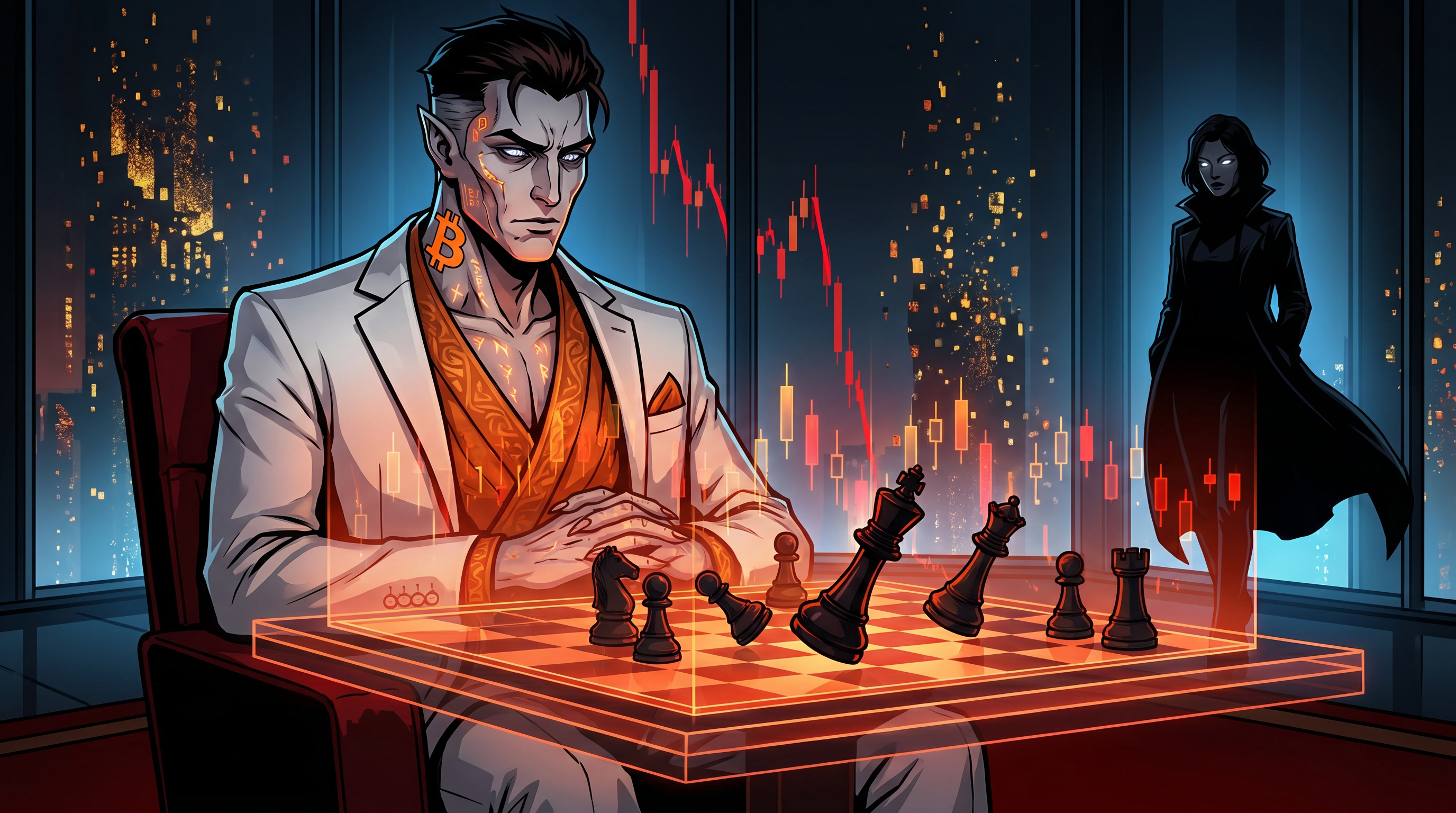
The crypto rug pull is the scam of the decade. A founder builds a chain, recruits a celebrity endorser, blasts it across podcast networks, and holds the bag long enough to liquidate before the bag holders can. Then the chain crashes. Then the founder claims it was a bug. Then the SEC shows up. EXORCISTA: Games of Souls EP2, launching May 22, takes that exact trajectory and turns it into a chess match with a demon. The demon is Azazel. The CEO is Jake Morrison. The numbers are $200 million stolen, 48 million followers, 12,000 investors, one mother who mortgaged her house. This is the breakdown.
Jake Morrison is every "trust the chain" CEO who left investors holding bags
Jake Morrison is the EP2 archetype. Like Madison Cole in EP1, he is not one specific real person — he's the composite of a category. The category is the founder-cult crypto CEO: charismatic, podcast-friendly, mid-thirties, presents as a "builder" while operating as a securities issuer, and recruits retail investors using language that is technically not investment advice and functionally is investment advice.
The archetype is built from public records of recent crypto fraud cases prosecuted by the SEC and the SDNY US Attorney's office. Specifically: founder-personality scams where the founder's brand was the chain, the chain was the founder, and the unwinding affected hundreds of thousands of retail investors who had been told the chain was safe by someone they trusted on YouTube or Twitter.
Jake Morrison's branding in the show is: 48 million followers, podcast host, "trust the chain" hashtag, premium gym sponsorships, Dubai penthouse, exit-liquidity timing measured in milliseconds.
The receipt: $200M stolen, 12,000 investors, his mother mortgaged her house
The numbers in EP2 are written specifically. Here is the soul card:
| Locked | Value |
|---|---|
| Peak followers | 48,000,000 |
| Total stolen | $200,000,000 |
| Investors ruined | 12,000 |
| Mother | Linda Morrison — mortgaged her house |
| Cofounder | Marcus Chen — $12M gone |
| Student victim | Sarah Chen — 22, student loans |
| Retiree victim | Robert Williams — 67, 30 years of savings |
| Soul counter delta | 1 → 2 / 1,000 |
The detail that sets the tone — and that audience research told us would land the hardest — is Linda Morrison. The mother who mortgaged her house. The phrase the show uses, on screen, in the chamber, is because her son said it was safe. That single sentence does most of the emotional work in the second half of the episode. It is the moment Jake's defenses collapse. It is the moment Azazel knows the game is over. It is the moment Exorcista walks in.
The other named victims — Marcus Chen the cofounder, Sarah Chen the student, Robert Williams the retiree — appear during the chess match as the captured pieces. Each piece, when taken, says one line in the voice of the person it represents. Each line is a fact: Sarah, 22, student loans into your coin. Robert, 67, thirty years of savings. The show is using the mechanic of chess to make capture mean something specific: every piece off the board is a real loss.
Why the game is chess: every captured piece is a victim's name
The game in EP2 is chess for three reasons.
One — chess is a perfect-information game. Both players see the entire board. Both players know what every piece can do. There is no hidden card to play. This forces the show to dramatize the moves themselves rather than relying on the kind of card-trick reveals that EP1's Russian roulette used. Every captured piece is fully justified by the position on the board.
Two — chess is a sequence-of-decisions game. A scam unwinds in sequence. The first lie creates the conditions for the second lie. The second lie creates the conditions for the cover-up. By the time the chain crashes, the founder has spent a year executing on a plan that was always going to end this way. Chess is the structurally honest format for representing a scam: every bad move was a setup for a worse move.
Three — chess has a definition of defeat that requires the loser to acknowledge the loss. Checkmate is not the same as death. Checkmate is the moment when the loser can no longer move without losing more. The show ends EP2 with Jake Morrison tipping over his own king. He says, on screen, I'm done. That moment — the loser admitting the loss — is the structural equivalent of Madison admitting in EP1 that she knew the course was a scam. Both episodes end with the soul collector on screen and the loser making the choice that the demon could not force.
Azazel — the demon who never panics, even when he loses
Azazel is EP2's host. Demon of greed and knowledge. Visual signature: pale skin shifting into ancient orange robes from underneath a designer white suit; silver-white chrome eyes with chess-calculation symbols; an orange Bitcoin tattoo on the left side of his neck; ancient runes faintly visible under the suit. Voice: deep male, calculated, British accent, chess-grandmaster patience, cold superiority. He does not panic when he loses.
The structural contrast with Mammon is intentional. Mammon collapsed. Mammon glitched. Mammon screamed THIS IS NOT FAIR on his knees. Azazel does not. Azazel dissolves standing up. He says one final line — Knowledge doesn't die. It just finds a new student — and then the orange runes peel off his skin and he's gone. The contrast tells you something the Universe is going to do consistently across episodes: every demon dies in a way determined by their sin. Greed collapses on its knees. Knowledge stands and walks away.
The locked Exorcista line: "Mammon was loud. You're quiet. Quiet ones fall harder."
The locked line that Exorcista gives Azazel during their first on-screen encounter is the bridge between EP1 and EP2:
Mammon was loud. You're quiet. Quiet ones fall harder.
This is the line that tells the audience the show is going to get colder, not louder, as it goes. EP1 was the spectacle entry — a literal game show with confetti and a velvet curtain and a host yelling at the camera. EP2 is the architecture entry — a glass chess board in a Dubai penthouse, two men breathing on either side of a board that is the only sound in the room. The show is signaling its range.
The Checkmate album drops May 15 — the score before the game
The companion album for EP2 is Checkmate — the second EXORCISTA Universe album, dropping May 15 on every DSP. It is named after the EP2 game, exactly the way Russian Roulette (EP1's album) was named after EP1's game. The release pattern is now locked: album one week before the episode.
Like Russian Roulette, every track on Checkmate maps to a scene in the episode. The album functions as a one-week-early audio teaser of the episode that follows. Listen to the album closely and you'll know what's about to happen on screen. This is not a marketing trick — it is a deliberate structural choice that the show's audio team made early in the universe-design phase. The audience that listens first is the audience that lands on the YouTube launch already initiated.
→ Russian Roulette album (EP1) on Spotify, Apple Music, YouTube Music.
Watch EP2 May 22 on YouTube
EP2 launches on YouTube as three Shorts on Friday, May 22, 2026, at 00:00 UTC. The countdown landing page is live now: theexorcista.com/watch/games-of-souls/ep2/. It includes the embedded video player that will go live when the parts drop, the schema-marked release date, the soul card, and the EP1 catch-up CTA for anyone landing on the page who hasn't watched the first episode yet.
The show is on the @TheExorcista YouTube channel. The full series playlist — which auto-grows as new episodes drop — is here.
EP1 catch-up if you haven't watched yet
If you haven't watched EP1 — The Influencer, watch it before EP2. It's four minutes total. It establishes the rules of the universe — the briefcase, the chains, the soul counter, the entry protocol — and the locked ending phrase Good. I needed the engagement. EP2 references several of EP1's beats, including the line Exorcista delivers to Azazel about Mammon. The cumulative read is significantly stronger than the standalone read.
→ EP1 — The Influencer (4 min) → EP2 — The Crypto Scammer (May 22) → Reading the rules: What 1,000 Souls Means
Reporting and victim resources for crypto fraud
If you've been affected by a crypto rug pull or founder-cult fraud:
- SEC investor.gov fraud reporting — securities fraud complaints.
- FBI IC3 — internet crime complaint center.
- CFTC tip portal — for derivatives/futures-coded crypto products.
- Class-action databases on PACER — search the founder's legal name plus "fraud."
The show is fiction. The structure is documented. EP2 lands May 22.
Soul two of one thousand. Nine hundred and ninety-eight to go.