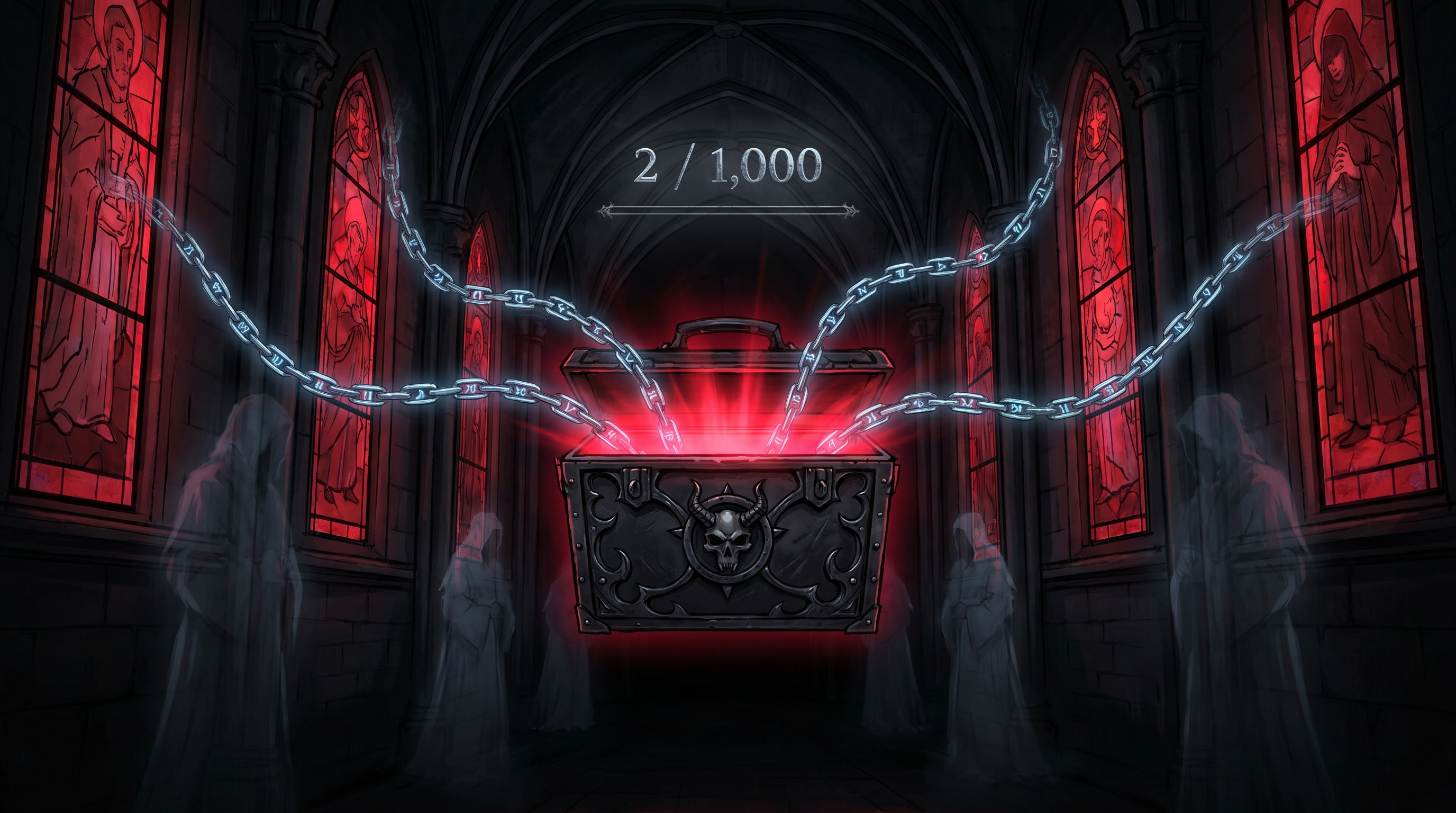
If you watched EXORCISTA: Games of Souls EP1 and EP2 and went looking for the rules — what 1,000 souls means, why the briefcase has a skull seal, why the chains come out of the briefcase and not from her coat — this is the canonical explainer. The Universe by Victoria Unikel has a rule set, and the show is internally consistent across episodes. This piece walks through every locked rule in the order you'd notice them.
The contract: why Exorcista has to collect exactly 1,000
The Universe runs on a contract. Exorcista is a collector — not a vigilante, not a hunter, not a judge. She has been assigned to collect exactly 1,000 souls. The number is locked. It is not metaphorical. It is the exact term of her contract.
The contract details get revealed across the season. What's locked already, after EP1 and EP2: the contract is binding regardless of her preference. She does not get to skip a soul she sympathizes with. She does not get to take an extra soul she dislikes. Each episode is one soul. The counter on screen — SOULS COLLECTED: N / 1,000 — increments only when collection is complete.
Why exactly 1,000? Because the contract was written that way. The deeper question — who wrote it — is a Season 1 reveal that the show is not in a hurry to give. What you can already infer from EP1 and EP2: the contract has counterparts on both sides. There is something in this universe that is owed 1,000 souls. There is something else that has agreed to deliver them. Exorcista is the courier.
→ The 1,000 Souls rule canonical page
Content Hell — what it is, who lands there, what it looks like
Content Hell is the destination. When a person targeted by the contract dies in the real world, they wake up in Content Hell — a personalized, localized version of the worst possible feed.
The look of Content Hell is engineered. For Madison Cole in EP1, it was the inside of her own coaching-course landing page rendered as a glowing physical game-show set: red velvet curtains, a confetti cannon that fires gold dollar signs, a single revolver on a black marble pedestal. For Jake Morrison in EP2, it was his Dubai crypto penthouse rendered as a holographic chess arena: glass chessboard, falling crypto candles on every wall, distant skyline of golden particles dropping into the void.
The rule of Content Hell's appearance is: it looks like the inside of the victim's own algorithm. Not a generic afterlife. Not a fire-and-brimstone underworld. The specific aesthetic of the platform that scaled their scam, twisted into the architecture of the lethal game they're now forced to play.
Who lands there? Public figures whose public-facing persona scammed, harmed, or hollowed out a meaningful audience. The Universe is selective. Most ordinary people do not go to Content Hell when they die. The contract specifies a category: fallen public figure. The category is wide enough to include influencer-coaches, crypto founders, predatory cult leaders, beauty-industry frauds, motivational-speaker grifters, celebrity pastors, nepo-baby liars. It is narrow enough to exclude the bystander.
The black iron briefcase with the skull seal
Exorcista carries a single object: a black iron briefcase, sealed with an engraved skull, locked with no visible key mechanism. The briefcase is the soul container. It opens when she opens it. It does not open for anyone else.
The skull seal on the briefcase is engraved, not glued, and the engraving is sigil-based — a circle, a star, a crescent moon, all interlocked. This is the same sigil that appears on her pendant. The Universe treats this sigil as the mark of the collector. It is the contract's signature.
Visual signature: when the briefcase opens, the interior glows red — the color of the souls inside. The glow brightens with each new soul collected. The audience can tell, by the brightness of the briefcase interior in the closing shot of any episode, roughly how many souls are inside. After EP2, the interior is brighter than it was after EP1.
The briefcase is silent unless she opens it. When she opens it, the chains come out.
The chains: where they come from, what they can't hold
The chains are the collection mechanism. They emerge from inside the briefcase — not from her coat, not from her hair, not from her hands. The briefcase is the source.
The chains are made of an iron-silver alloy that the Universe has not yet named. They glow cold blue when active. They wrap around the soul of the collected target and pull the soul into the briefcase. The chains do not harm the body of the deceased — that body is already gone, in the real world, where it died of whatever caused the death. The chains operate on the soul object only.
The chains have a sound. Five distinct sound categories, in fact, each used for a different beat:
- DRAG — the heavy scrape of chain on stone, played the moment Exorcista enters Content Hell. Always the first sound after the silence.
- WHIP — fast, high-pitched chain through air. Used during attack moments.
- COIL — the wrapping sound, used when the chains coil around a soul to take it home.
- LOCK — the briefcase lock engaging, played at the moment of collection.
- ERUPTION — chains exploding outward from the briefcase in heavy combat scenes. Reserved for big moments.
These five sounds are part of the brand. They appear in every episode and on the album.
What the chains can't hold: a soul that has already chosen its own ending. If the target tips their own king before she walks in — like Jake Morrison did at the end of EP2 — the soul is already collected. The chains are still used for visual continuity, but the work is already done. The Universe is making a point: the collection is consensual, eventually. The host can cheat and force a player into the chamber. The chains take the soul out. But the soul has to admit it lost first. That is the rule.
The entry protocol: silence, drag, theme, four cuts, line
Every Exorcista entry into Content Hell follows the same six-step protocol. This is locked. It will appear in every episode.
- All ambient music HARD CUTS to silence. Two seconds of total quiet. The audience knows what's coming.
- SFX-CHAINS DRAG. The single heavy scrape of chain on stone.
- The theme music starts — Hellfire Chains on the album, SUNO-K in the audio canon.
- The 4-cut signature. Four cuts in fast sequence: case → silver eyes → chains → turn.
- Her final line of the episode. Different in every episode. EP1: Good. I needed the engagement. EP2: Good. I needed the exercise.
- The soul counter increments on screen. SOULS COLLECTED: N / 1,000.
The protocol is the show's signature beat. Audiences memorize it after one episode. By EP2, the protocol becomes a meta-beat — the audience anticipates each step, and the show plays the anticipation against them by adjusting the timing slightly. The 2-second silence in EP2 is closer to 3 seconds. The audience leans forward. The drag arrives at the exact moment the audience can no longer hold its breath. This is intentional.
The host rule: every demon is a different sin, every game is different
The Universe has ten demons in Season 1. Each demon hosts one episode. Each demon represents one specific sin. Each demon runs one specific lethal game determined by their sin.
Confirmed so far:
- Mammon — sin: GREED, game: Russian Roulette. The demon of accumulation. Cannot refuse a bet. Hosted EP1.
- Azazel — sin: GREED/KNOWLEDGE, game: Chess. The demon of strategic accumulation. Cannot admit he was wrong. Hosted EP2.
Eight more demons coming through Season 1. Each will follow the same rule: a sin, a game determined by the sin, a weakness determined by the sin, and a defeat that follows from the weakness.
Why this matters as a worldbuilding rule: it constrains the show in a useful way. The writers cannot just invent any game for any episode. The game has to follow from the sin. Greed gets games of accumulation — the chamber, the board. Pride will get games of comparison. Sloth will get games of stillness. Wrath will get games of speed. The constraint forces creative variety while keeping the universe coherent.
→ Mammon, Azazel & the Demons of Games of Souls
Locked rules of the Universe — what NEVER changes
These rules are locked across the entire series. They cannot be retconned. They cannot be modified.
- Exorcista is the only constant. She appears in every episode. No other character does, except as cameo.
- The host always cheats. No exceptions.
- The host always loses. No exceptions.
- The collection is consensual. The target has to admit they lost. The chains do the rest.
- The soul counter only counts up. It cannot decrement. It cannot reset.
- The contract is binding. Exorcista cannot skip, swap, or refuse a target.
- Her name is Exorcista, not "the Exorcista." A character, not a title.
- Her weakness is her daughter. Revealed gradually across the season.
- Universe creator: Victoria Unikel. The world is hers. The rules are hers.
Where each rule was first revealed (EP1, EP2, …)
For the lore-tracker readers:
- The contract — referenced in EP1 Part 3, fully named in EP2 Part 1 by Azazel.
- The 1,000 number — counter first appeared in EP1 Part 3 closing card.
- The briefcase + chains mechanism — full sequence in EP1 Part 3 collection beat.
- The entry protocol — established in EP1 Part 1, repeated identically in EP2 Part 1 (small timing variation).
- The "host always cheats" rule — established by Mammon's hidden card move in EP1 Part 2.
- The "host always loses" rule — confirmed by both EP1 (Mammon's collapse) and EP2 (Azazel's standing dissolution).
- Her daughter as weakness — first hinted in EP2 Part 3 mirror fragment shot.
Read more on the Universe
- The 1,000 Souls rule — full canonical page
- Exorcista — character profile
- Mammon — character profile
- Azazel — character profile
- Victoria Unikel — creator profile
- External: Mammon on Wikipedia · Azazel on Wikipedia · Seven Deadly Sins on Wikipedia · EXORCISTA Universe on Wikidata
The Universe runs on rules. The rules don't bend. Soul two of one thousand has been collected. The contract continues.
→ Watch EP1 — The Influencer · EP2 — The Crypto Scammer (May 22) · Full lore hub